Why Your Air Conditioner Keeps Tripping the Breaker
Why Your Air Conditioner Keeps Tripping the Breaker
Breaker trips are one of the clearest warning signs that an air conditioning system in Phoenix is under electrical stress. In a desert city where summer design temperatures run from 110 to 117 degrees and west-facing equipment pads can hit 130 to 140 degrees in afternoon sun, even a small electrical weakness can turn into a no-cooling shutdown fast. For homeowners dealing with repeated shutoffs, this is usually an Emergency AC Repair issue, not a nuisance to ignore until the weekend.
In Phoenix, AZ, breaker trips tend to show up during the hottest part of the year, especially across Arcadia, Biltmore, Ahwatukee, Desert Ridge, Maryvale, and North Phoenix when systems are already running near full demand for long stretches. A breaker is doing its job when it cuts power. It is protecting the wiring and the equipment from overheating, short circuits, or motor damage. What matters is why the breaker had to step in. In many cases, the tripping is tied to a failing run capacitor, a dirty condenser coil, a compressor drawing too many amps, a blower motor problem, a loose electrical connection, or a refrigerant issue that is forcing the system to work harder than it should.
That pattern matters in Maricopa County because Phoenix cooling systems operate under conditions that are harsher than most of the country. June through September monsoon dust events pack condenser coils with caliche fines. Day & Night Air Conditioning, Heating & Plumbing regularly sees outdoor units lose 15 to 25 percent of cooling capacity after haboob dust loads the coil. When that happens, amperage rises, head pressure climbs, and breaker trips become more likely. A repeated trip is often the point where a hidden performance problem finally becomes impossible to miss, which is why this kind of failure often turns into a same-day Emergency AC Repair call.
What a tripping breaker usually means in a Phoenix AC system
An air conditioner does not trip a breaker without cause. The breaker is calibrated to open the circuit when current draw climbs past a safe limit. In plain terms, the system is HVAC company in Maricopa County AZ pulling more electricity than the circuit should carry. That can happen in a quick surge, or it can build over time as heat, dirt, weak components, and worn motors stack stress on the system.
The most common scenario in Phoenix is heat-related electrical strain at the outdoor condensing unit. That outdoor cabinet holds the compressor, condenser fan motor, contactor, and run capacitor. The compressor is the pump that circulates refrigerant through the system. The run capacitor is the cylindrical electrical component that stores and releases the energy pulse needed to keep the compressor and fan motor running properly. When that capacitor weakens, the motor may still start, but it draws more amperage doing the same work. On a 115-degree afternoon near Loop 202 or I-10, that extra strain can be enough to trip the breaker.
Another frequent cause is a dirty condenser coil. The condenser coil is the metal tubing and fin surface in the outdoor unit that releases heat from the home to the outside air. In Phoenix, that heat rejection job is already difficult because the outdoor air is so hot. Add monsoon dust, cottonwood debris, or a blocked coil from neglected maintenance, and the system has to run at higher pressure. Higher pressure means more compressor load. More compressor load means more current draw. That chain reaction often ends with Emergency AC Repair.
Indoor airflow restrictions can trigger the same result from another direction. If the evaporator coil, which is the indoor coil that absorbs heat from the air, gets too cold because the filter is clogged or the blower motor is weak, ice can form on the coil. A frozen coil blocks airflow even more. The refrigerant returning to the compressor may no longer be in the right condition. The compressor overheats, current spikes, and the breaker trips. Many homeowners notice the trip first and the ice second.
Phoenix climate makes breaker problems show up faster
Phoenix sits in ASHRAE climate zone 2B, a hot-dry desert climate. That matters because high sensible heat loads dominate most of the cooling season. Roof orientation, west glass exposure, attic insulation quality, and duct leakage all affect how hard the system must run. In neighborhoods like Biltmore 85016, Arcadia 85018, and Sunnyslope 85020, older homes often have aging ductwork, weak attic sealing, and older electrical components. In Ahwatukee 85044 and 85048 or Desert Ridge 85050, the equipment may be newer, but the long run hours still punish weak parts.
A locally specific detail that many homeowners do not expect is how hot the space around the outdoor unit gets in Phoenix. Air temperature may read 113 degrees, but the equipment pad on a west exposure can run 130 to 140 degrees in direct sun. That heat shortens the life of capacitors, contactors, insulation on wires, and fan motors. Day & Night technicians see a disproportionate number of run capacitor failures every June and July for exactly this reason. That is one of the most common triggers behind Emergency AC Repair in Phoenix.
Monsoon season adds another layer. Dust storms from June through September coat condenser coils and work their way into electrical compartments. The coil can no longer reject heat effectively, and contactor points, which are the heavy-duty electrical switch contacts that open and close power to the compressor, can pit or weld from repeated high-load cycling. Once that happens, breaker trips may start during startup or midway through a cooling cycle. Around Camelback Mountain, South Mountain Park, and the Phoenix Sky Harbor corridor, this pattern is common enough that it shapes the summer diagnostic routine.
The most common failures behind repeated breaker trips
In a Phoenix service market, the causes are usually mechanical or electrical, and often both at once. A proper diagnosis is not guesswork. It starts with measuring what the system is doing under load.
- Weak run capacitor: the compressor or condenser fan motor struggles to start or run and draws excess amperage.
- Dirty condenser coil: monsoon dust and debris raise refrigerant pressure and compressor load.
- Failing compressor: the refrigerant pump overheats, locks up, or draws high current during startup.
- Blower or airflow problem: a clogged filter, weak blower motor, or frozen evaporator coil throws the refrigeration cycle out of balance.
- Shorted wiring or bad contactor: damaged insulation, loose lugs, or pitted contacts create electrical faults.
The run capacitor is usually the first place a trained technician looks in summer. A capacitor can fail completely, but in Phoenix it often weakens gradually first. The unit may still cool at 8 AM and trip the breaker at 4 PM because the component cannot handle the hotter load later in the day. A capacitance meter confirms whether the measured value still matches the part rating. Guessing at this part without testing leads to missed problems and repeat calls.
The compressor is another major suspect. A compressor that is overheating may draw high amperage, trip on internal overload, or pull a hard startup surge that the breaker does not tolerate. Sometimes the root cause is the compressor itself. Sometimes it is low refrigerant charge from a leak, a blocked coil, or a failed TXV valve, which is the thermostatic expansion valve that meters refrigerant into the evaporator coil. If the system has been running low on charge for months, the compressor may already be damaged by the time the breaker starts tripping. That is why repeated trips should be treated as Emergency AC Repair when cooling has become unreliable.
Contactor failure is less talked about by homeowners, but it matters. The contactor is the electrical switch inside the outdoor unit that receives the thermostat signal and sends line voltage to the compressor and condenser fan motor. In Phoenix heat, contactor points can pit, carbonize, or weld. A pitted contactor can cause voltage drop. Low voltage makes motors run hotter and draw more amps. A welded contactor can create erratic operation and unsafe electrical behavior.
Why breaker trips are often tied to airflow problems inside the house
Not every breaker problem starts outdoors. Indoor airflow can push the system into the same kind of electrical stress. In many Phoenix homes, especially mid-century houses in Encanto, Camelback East, and parts of North Central Phoenix, original ductwork leaks substantial supply air into the attic. Day & Night regularly finds older duct systems losing 35 to 40 percent of conditioned air before it reaches the rooms. That means the thermostat keeps calling for cooling longer, the system runs hotter, and marginal electrical parts fail sooner.
The air filter also matters more than many homeowners realize. A high-efficiency filter can be useful, but if the duct system and blower were not designed for the added resistance, airflow drops. A MERV 13 filter, which captures finer particles than a MERV 8 filter, may be too restrictive for some older systems. Reduced airflow can freeze the evaporator coil, flood liquid refrigerant back toward the compressor, and set up the exact conditions that lead to breaker trips.
Blower motor issues show up the same way. The blower motor is the indoor fan motor that moves air across the evaporator coil and through the ductwork. When it weakens, airflow falls. The home may feel warmer, some rooms may lose supply air, and the coil may ice. The breaker trip may happen at the outdoor unit, but the chain of failure began in the air handler. This is why an Emergency AC Repair diagnosis has to look at the full refrigeration and airflow system rather than just the breaker panel.
The refrigerant side of the problem cannot be ignored
Breaker trips often intersect with refrigerant problems. Low refrigerant charge from a leak can overheat the compressor. A metering problem at the TXV valve can starve or flood the evaporator. A fouled indoor coil can distort pressures. These are not visible from the thermostat or from the breaker panel. Proper diagnosis requires pressure readings, temperature measurements, and charge verification using superheat and subcooling. Those are the field methods used to confirm whether the refrigerant circuit is operating within specification.
This matters more in 2026 because Phoenix homeowners are making repair-versus-replacement decisions under the federal refrigerant transition. New equipment manufactured after January 1, 2026 has shifted from R-410A to R-454B under the EPA SNAP rule. R-454B is an A2L mildly flammable refrigerant with a global warming potential of 466, far below R-410A at 2,088. Existing R-410A systems can still be serviced, but refrigerant economics will continue changing as the market moves forward. If a breaker trip traces back to a compressor failure on an aging R-410A system, the decision may no longer be just about one part. It may be about the entire future of the system.
That does not mean every breaker trip calls for replacement. Many do not. In fact, a large share of Emergency AC Repair calls in Phoenix are solved with a confirmed capacitor replacement, coil cleaning, contactor replacement, blower repair, or a refrigerant leak repair when the system is otherwise in good condition. The key is accurate testing before any recommendation is made.
Why rule-of-thumb equipment sizing makes this worse in Phoenix
Breaker trips are more common in systems that were incorrectly sized from the day they were installed. Phoenix has a long history of square-footage sizing shortcuts. A contractor sees the home size, assigns a tonnage number, and installs equipment without a Manual J Residential Load Calculation under ACCA Standard 1. That shortcut causes trouble in both directions.
An undersized system may run almost nonstop through a Phoenix summer, especially in homes with high west exposure, poor attic insulation, or leaky ducts. Long run time drives component temperatures up and shortens the life of capacitors, contactors, and compressors. An oversized system has its own problems. It short cycles, starts more often, and stresses electrical components every time it ramps on. Frequent starts are hard on capacitors and compressors. That pattern often shows up in newer subdivisions and older remodels alike.
For homeowners who search terms like ac repair near me or air conditioning repair after another breaker trip, the hidden issue may be that the system has been working against a poor load match for years. In Phoenix, Manual J, Manual S equipment selection, and proper duct design are not extra paperwork. They are what separates a stable system from one that keeps failing in July.
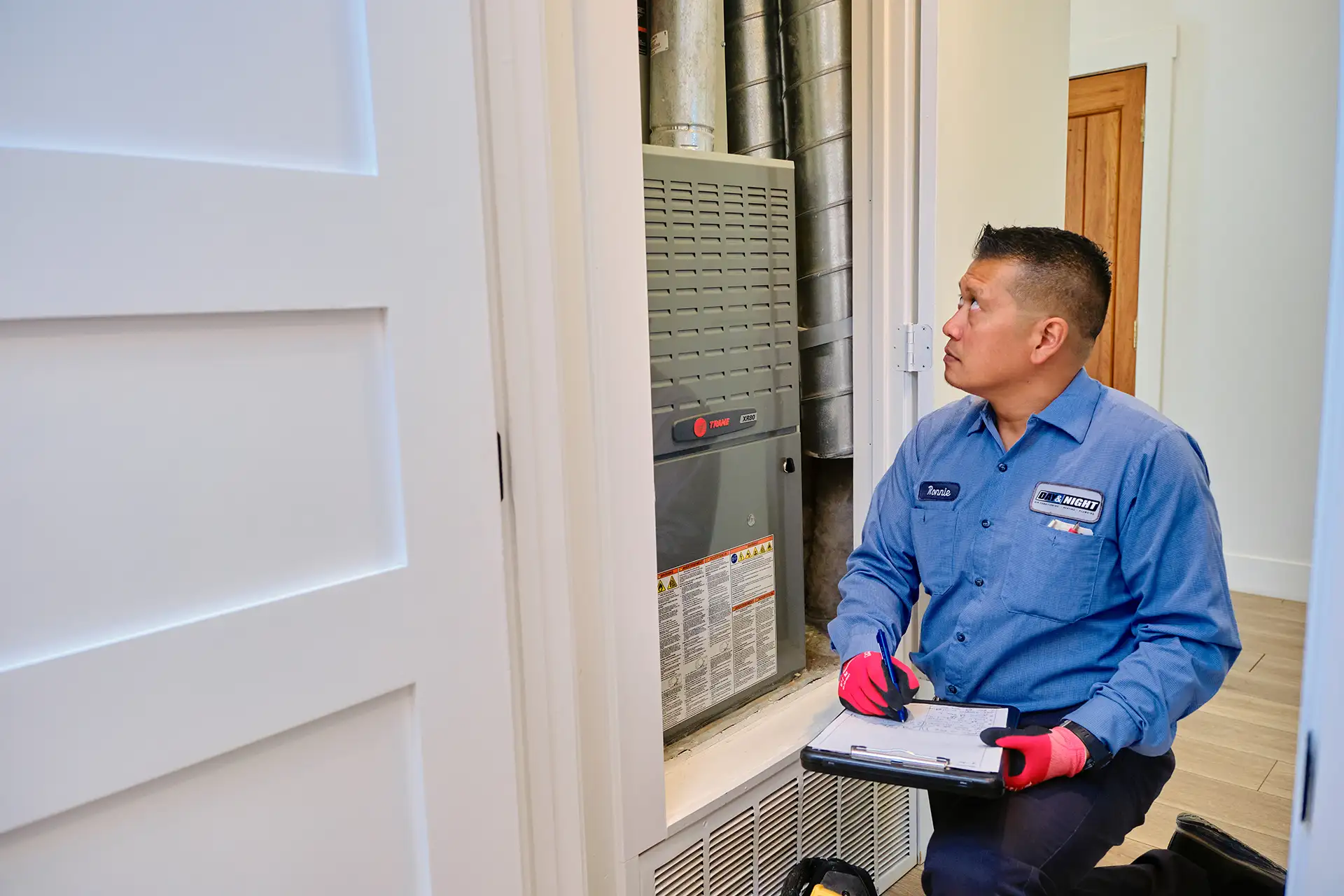
What a real diagnostic process looks like on an Emergency AC Repair call
With repeated breaker trips, the first priority is to determine whether the fault is electrical, mechanical, refrigerant-related, or a combination. On a true Emergency AC Repair call, a trained technician checks the breaker size and condition, verifies voltage, measures amp draw, tests the run capacitor with a capacitance meter, inspects the contactor, and examines wire connections for heat damage. The condenser coil condition is inspected because monsoon fouling is such a strong local factor in Phoenix.
After that, the system must be evaluated as an operating machine, not just a collection of parts. Refrigerant pressures and line temperatures reveal whether the charge is correct. Supply and return temperatures show whether the air side is moving enough heat. The blower assembly and filter are checked to confirm airflow. The evaporator coil is inspected for ice or heavy dirt. The condensate drain line and float switch are also part of the process because a clogged condensate line can shut a system off and create confusion about whether the breaker or the safety switch caused the failure.
This distinction matters because parts can be replaced unnecessarily if testing is shallow. A breaker that trips because a compressor is locked up will often return to the same failure even after a capacitor swap. A dirty coil that has driven head pressure high all monsoon season may cause the next capacitor to fail early if the coil is left dirty. Real Emergency AC Repair means diagnosing the cause chain, not replacing one symptom.
Older Phoenix homes add another layer of risk
Across Arcadia, Biltmore, Coronado, Willo, and parts of Maryvale, many homes have older service panels, older disconnects, aging whips, and retrofit air conditioning systems that have been modified more than once. That does not automatically mean the electrical system is unsafe, but it does mean a breaker trip deserves a closer look. Loose connections at the disconnect, undersized conductors from an old installation, sun-damaged insulation, and worn breakers can all contribute.
In these homes, Day & Night technicians often find that the air conditioner is not the only system under stress. Duct leakage, poor return air design, attic heat gain, and deferred maintenance stack together. The result is a system that runs long hours and trips the breaker under extreme heat. It is easy to blame the last failed part. It is harder, and more useful, to identify the system conditions that keep causing the same failure. That is where an experienced local contractor earns trust on an Emergency AC Repair call.
When a breaker trip points to repair and when it points to replacement
There is no honest one-size answer. If the failure is a weak capacitor, dirty coil, bad contactor, blower issue, or isolated electrical repair on a sound system, repair often makes sense. If the compressor is failing on an older unit, the evaporator coil is leaking, the refrigerant is R-410A on a system already near end of life, and the installation was poorly sized to begin with, replacement may be the more stable long-term path.
That is where Phoenix-specific context matters. Starting in 2026, new systems must meet current Southwest efficiency standards, including the 14.3 SEER2 and 11.7 EER2 minimum for split systems under 45,000 BTU. A proper replacement should also be sized with Manual J and matched with the duct system. If replacement becomes necessary after a severe breaker-related failure, that work should account for the desert load, not just the square footage. For homeowners considering AC installation after repeated repair issues, rebate support may matter too. APS Cool Rewards can offer up to $2,000 for qualifying heat pump installations, SRP HVAC rebates can reach up to $1,500 for qualifying high-efficiency equipment, and the federal Inflation Reduction Act Section 25C credit can add up to $2,000 annually for qualifying heat pumps. Those incentives do not change whether the breaker trip needs diagnosis first, but they do affect the economics when a major failure has already happened.
Signs the situation has moved beyond a routine service call
Some breaker trips can wait until the next open appointment. Others are true summer emergencies in Phoenix. If the house is climbing into the high 80s or 90s indoors, if the breaker trips immediately on reset, if there is a burned electrical smell, if the outdoor unit hums but does not start, or if an elderly resident, infant, or medically vulnerable person is in the home, this has crossed into Emergency AC Repair territory. In a Phoenix July, same-day response is a health issue as much as a comfort issue.
- The breaker trips again as soon as the thermostat calls for cooling.
- The outdoor unit buzzes, clicks, or struggles to start.
- Warm air is coming from the vents even before the breaker trips.
- Ice is visible on the refrigerant line or indoor coil area.
- A burning smell or visible discoloration appears near the disconnect or breaker panel.
These symptoms point to conditions that should be tested quickly. Resetting the breaker over and over can make the damage worse, especially if the compressor is the component drawing locked-rotor amperage during startup. That is one of the fastest ways to turn a smaller electrical repair into a larger system failure.
Why local experience matters on this specific problem
Phoenix AC work is not generic AC work. A contractor who spends every summer around I-17, SR 51, Loop 101, and Loop 202 learns the local failure patterns in a way that does not show up in a national checklist. Capacitors fail faster here. Condenser coils load with dust faster here. Rooftop packaged units on commercial properties bake harder here. Homes in 85040, 85044, and 85048 may have different load and duct patterns than homes in 85016 or 85018, but they all share extreme cooling demand.
Day & Night Air Conditioning, Heating & Plumbing has served Phoenix and Maricopa County since 1978 from its headquarters on E La Salle St in 85040. That long local track record matters because breaker-tripping diagnostics are often about judgment as much as meters. Arizona ROC C-39 air conditioning and refrigeration licensure, EPA Section 608 certification, and current R-454B transition training all matter on the technical side. So does knowing how Phoenix housing stock behaves by neighborhood and age.
That experience also matters when the problem extends beyond one part. If a system failure reveals poor duct design, a mismatched installation, or another issue that points toward replacement, the next step has to be grounded in real load calculation and current standards. If the issue is repairable, the homeowner still needs a clear written price before work begins and a realistic explanation of what failed, why it failed, and whether there are larger system conditions that should be addressed next. That is the difference between a one-time fix and a repeat cycle of Emergency AC Repair.
What Phoenix homeowners should expect from the service side
A local authority service page should be honest about what residents want most when the house is heating up. They want the system diagnosed correctly. They want to know if the problem is minor, moderate, or major. They want to know whether the repair is likely to hold or whether the unit is moving toward replacement. They want a technician who understands the effects of monsoon dust, west sun exposure, duct leakage, older electrical retrofits, and the 2026 refrigerant transition.
They also want response time. In Phoenix, after-hours cooling failure is not treated casually. Day & Night Air Conditioning, Heating & Plumbing provides 24/7 service across Phoenix and the broader Maricopa County area, including Arcadia, Biltmore, Ahwatukee, Desert Ridge, Sunnyslope, Encanto, Paradise Valley Village, South Mountain, and neighboring cities throughout the Valley. Same-day service is available for urgent repairs, and the company uses upfront flat-rate pricing so the HVAC services in Maricopa County AZ homeowner sees the cost before repair work begins. That matters on an Emergency AC Repair call because the decision often has to be made quickly, under real heat stress, without room for vague answers.
For homeowners whose breaker problem ends up pointing toward a full system changeout, Day & Night also handles installation work with Manual J load calculation, current SEER2 standards, financing through approved lenders, free estimates on new HVAC systems, and a 10-year parts and labor warranty on qualifying new installations. The company carries strong local trust signals as well, including a 4.9 star Google rating across more than 9,400 verified reviews, Google Guaranteed status, BBB A+ accreditation, and NATE-certified technicians where applicable.
For a Phoenix home where the air conditioner keeps tripping the breaker, the next move is a real diagnostic visit, especially when cooling is already unstable. Day & Night Air Conditioning, Heating & Plumbing handles Emergency AC Repair across Phoenix, AZ and Maricopa County with 24/7 emergency availability, same-day service, upfront flat-rate pricing, and technicians trained for both legacy R-410A systems and the post-2026 R-454B equipment standard. After more than 40 years in Phoenix since 1978, the company knows the difference between a simple capacitor failure and the kind of compressor or airflow problem that keeps coming back. For immediate Emergency AC Repair, Phoenix homeowners can call (602) 492-9656 to schedule service.
Phoenix, AZ 85040