Why Maricopa County AC Units Blow Warm Air Upstairs
Why Maricopa County AC Units Blow Warm Air Upstairs
Warm air upstairs is one of the most common summer comfort complaints in Phoenix, AZ and across Maricopa County. It is also one of the clearest signs that Emergency AC Repair may be needed before a small performance issue turns into a full system failure. In two-story homes from Ahwatukee Foothills 85044 to Desert Ridge 85050, the upstairs level absorbs more solar heat through the roof, attic, west-facing walls, and upper windows. When the air conditioner is already under stress from 110 to 117 degree design temperatures and afternoon equipment pad temperatures that can reach 130 to 140 degrees, the upper floor is usually the first place where the system shows weakness.
That problem has a strong local pattern. Homeowners in Arcadia 85018, Biltmore 85016, North Phoenix, Sunnyslope 85020, and Maryvale 85033 often report that the downstairs still feels acceptable while the bedrooms upstairs blow warm air from the vents or never seem to cool down after noon. In many cases, the issue is not one single cause. It is a stack of Phoenix-specific stresses that includes monsoon dust packed into the condenser coil, failing run capacitors inside the outdoor unit, low airflow through older ductwork, thermostat control issues, and low refrigerant charge from a leak at the evaporator coil or TXV valve, which is the metering device that regulates how much refrigerant enters the indoor coil.
For households with children, older adults, or anyone working from home on the second floor, Emergency AC Repair becomes less about convenience and more about basic habitability. July and August overnight indoor temperatures can stay dangerously high after a system loses capacity. A house that wakes up at 82 degrees downstairs can already be pushing the upper 80s upstairs before sunrise. That is why warm air upstairs in Maricopa County should be read as a system warning, not as a normal trade-off of desert living.
Why upstairs failures show up first in Phoenix homes
Phoenix sits in ASHRAE climate zone 2B, which is hot and dry for most of the cooling season, with a short monsoon period that adds humidity and dust from June through September. In a two-story house near South Mountain Park, along Loop 202, or in newer subdivisions near Paradise Valley Village, the second floor takes the brunt of the heat load. Heat rises inside the structure. The attic above the second floor can reach extreme temperatures. West-facing bedrooms pick up direct afternoon solar gain. If the AC system loses even 10 to 15 percent of cooling capacity, the upper floor shows it first.
This is one reason the Phoenix market sees so many calls that start with a comfort complaint and end with Emergency AC Repair. A system may still be technically running. The thermostat may still be calling for cooling. The blower motor may still be moving some air. But the air coming from the upstairs supply registers is lukewarm or only slightly cool, and the space temperature keeps climbing. In the field, that often points to a system that is alive but no longer producing full refrigeration effect.
There is also a housing stock issue unique to many parts of Maricopa County. In older Arcadia, Encanto, and Biltmore homes, original ductwork can leak a large share of conditioned air into the attic before it reaches the second floor registers. In some mid-century and late 1970s homes, field conditions show duct losses in the 35 percent range when the ducts were never sealed or replaced. That is a shareable local fact because it surprises homeowners: a system can be cooling properly at the equipment, yet the upstairs still receives weak or warm airflow because the attic is getting the conditioned air instead of the bedrooms.
The most common reasons AC units blow warm air upstairs in Maricopa County
Warm air upstairs does not always mean the compressor has failed. It often means the system has lost part of its cooling ability and the upper floor is exposing the weakness. In Phoenix service conditions, several failure patterns show up again and again.
- Run capacitor failure, which means the cylindrical electrical component in the outdoor unit can no longer deliver the stored energy pulse needed to start and keep the compressor and fan motor running correctly.
- Condenser coil fouling from monsoon dust and caliche fines, which insulate the coil and reduce heat rejection to the outdoor air.
- Low refrigerant charge from a leak, which reduces the system’s ability to absorb indoor heat at the evaporator coil.
- Duct leakage or low airflow, especially in older attic duct systems serving upstairs rooms.
- Thermostat or zoning imbalance, where the system cycles off based on downstairs conditions before the upper floor reaches target temperature.
Each of those conditions can create a warm-air complaint upstairs, but they do it in different ways. That is why legitimate Emergency AC Repair starts with testing, not guessing. A technician has to identify whether the problem is electrical, refrigerant-related, airflow-related, or distribution-related before any repair decision makes sense.
Run capacitor failure in Phoenix heat
In Maricopa County, run capacitor failure is one of the most common reasons a system starts blowing warm air upstairs. The run capacitor is the small metal can inside the outdoor condensing unit that stores and releases electricity to help start and run the compressor motor and fan motor. In west-exposure installations near Camelback Mountain, I-17 corridors, and open-lot subdivisions with little shade, outdoor unit pads can hit 130 to 140 degrees on summer afternoons. That repeated thermal stress shortens capacitor life.
When the capacitor weakens, the compressor may struggle to start or may not start at all. The outdoor fan may still run, which misleads the homeowner into thinking the AC is operating normally. Indoors, the air handler blower may keep pushing air through the vents, but because the refrigeration cycle is not doing its job, the upstairs vents blow warm air. This is a classic Emergency AC Repair call in Phoenix because the house can heat up fast even though the system sounds active.
Proper diagnosis means using a capacitance meter to test the actual microfarad value of the capacitor against the manufacturer rating. A visual guess is not enough. A swollen or leaking capacitor is easy to spot, but many failed units look normal from the outside.
Condenser coil fouling after monsoon dust events
From June through September, haboob dust events can pack the outdoor condenser coil with very fine caliche and desert dirt. The condenser coil is the outdoor heat-release surface. If it is coated with dust, the system cannot reject indoor heat effectively. Field performance in Phoenix shows this can cut cooling capacity by roughly 15 to 25 percent until the coil is properly cleaned. That number matters because a 20 percent capacity loss might still leave the downstairs livable while making the upstairs miserable.
This is another reason homeowners search for Emergency AC Repair right after a storm. The system did not always “break” in the usual sense. It lost performance. In a one-story house, that may show up as longer run times. In a two-story house, it often shows up first as warm air or weak cooling upstairs. Condenser coil cleaning has to be done correctly. Bent fins, trapped debris, and incorrect water pressure can make the problem worse if handled carelessly.
Low refrigerant charge and leak-related warm air
If an AC system is low on refrigerant, it cannot move heat out of the house efficiently. Refrigerant is the working fluid that absorbs indoor heat at the evaporator coil and rejects it outdoors at the condenser coil. In many Phoenix systems, leak points show up at the evaporator coil, braze joints, or TXV valve connections. As charge drops, supply air temperature rises and the upstairs loses comfort first.
Low charge can also cause the indoor evaporator coil to freeze. That sounds backward in a warm-air complaint, but it is common. Ice forms on the coil because pressure and temperature inside the coil drop too low. Once airflow is blocked by ice, the vents can start blowing little air or warm air. Real Emergency AC Repair in that situation means verifying the charge with superheat and subcooling measurements, which are the standard methods used to confirm whether the refrigerant level matches the operating conditions. It does not mean simply “adding Freon” and leaving.
The 2026 refrigerant transition also matters here. New equipment manufactured after January 1, 2026 uses R-454B under the EPA SNAP rule rather than R-410A. Existing R-410A systems can still be serviced, but repair decisions on older leaking units are changing because refrigerant economics are shifting. That does not cause warm air upstairs by itself, but it does affect the repair-versus-replacement discussion when an emergency call uncovers a major refrigerant leak.
Airflow restrictions and upstairs duct losses
Many upstairs comfort complaints in Phoenix trace back to airflow. The blower motor may be working, but the system may not be moving enough air through the upstairs duct runs. Common restrictions include dirty air filters, collapsed flex duct, closed balancing dampers, undersized return ducts, and attic duct leakage. In homes near Phoenix Sky Harbor Airport and Central Phoenix neighborhoods with older retrofits, it is not unusual to find second-floor supply runs that were extended or modified years ago without proper Manual D duct design.
Air filter choice matters too. A MERV 13 filter can capture smaller particles than a MERV 8 filter, but if the duct system and blower are not designed for the added resistance, airflow can drop. Reduced airflow across the evaporator coil lowers capacity and can even lead to freezing. The homeowner experiences this as poor upstairs cooling and may need Emergency AC Repair even though the root problem began as an airflow issue rather than a compressor failure.
Why square-foot sizing mistakes make upstairs rooms worse
Some Maricopa County homes have a deeper problem: the equipment was sized by rule of thumb instead of by Manual J Residential Load Calculation under ACCA Standard 1. Manual J is the accepted method for sizing residential cooling systems based on actual heat gain. It accounts for orientation, insulation, windows, infiltration, occupancy, and local design temperatures. In Phoenix, those variables matter far more than a simple square-foot estimate.
When a system is oversized by 30 to 50 percent, which happens often in the desert when contractors rely on tonnage-per-square-foot shortcuts, the unit cools the thermostat location too quickly and shuts off before the upstairs gets enough run time. This can create a familiar complaint: the downstairs near the thermostat feels acceptable, but the second floor stays warm. During monsoon humidity, short cycling also means poor moisture removal. The home feels clammy and uneven, which is not typical of a correctly operating desert AC system.
This is important because some homeowners call for Emergency AC Repair when the actual issue is poor system design, poor duct design, or both. Repair may still be needed if a component has failed, but long-term comfort upstairs depends on matching the equipment, ductwork, and load profile of the house. In newer replacement scenarios, that is where Manual J, Manual S equipment selection, and Manual D ductwork review become critical.
What a proper diagnostic process looks like on an emergency call
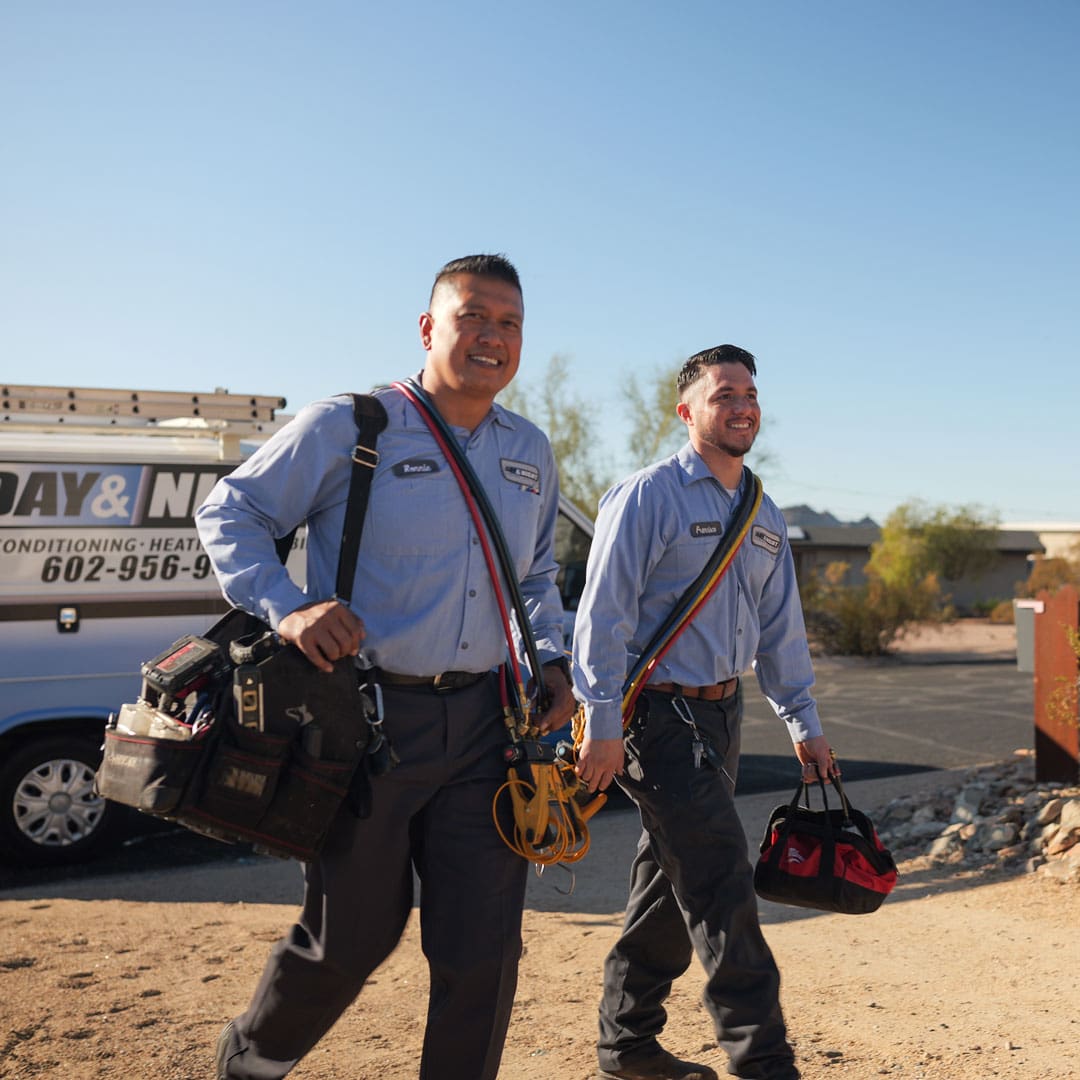
For warm air upstairs, a legitimate diagnostic process has to go beyond checking whether the outdoor unit is running. Day & Night Air Conditioning, Heating & Plumbing handles Emergency AC Repair by isolating the failure point and confirming the actual cause before repair options are presented. That matters in Phoenix because multiple symptoms can look the same from the living room.
The technician starts with thermostat verification, electrical checks, airflow observations, temperature split readings, and outdoor unit operation. If the compressor best HVAC company Maricopa County or fan motor is not performing correctly, the run capacitor and contactor are tested. The contactor is the electrically controlled switch that sends power to the outdoor unit, and in heavy-duty Phoenix use it can fail from pitting or welded contacts. If refrigerant performance is in question, the technician measures pressures, superheat, and subcooling to determine whether the system is undercharged, overcharged, restricted, or experiencing a metering problem at the TXV valve.
Airflow diagnostics are just as important. A frozen evaporator coil, a failed blower motor, a clogged condensate drain line tripping a float switch, or severe duct leakage can all mimic a refrigerant issue from the homeowner’s point of view. In many two-story homes near Loop 101 and SR 51 corridors, the real reason the upstairs blows warm air is that the system is splitting limited airflow badly between floors. A proper diagnosis identifies whether the system is failing to make cold air, failing to move enough air, or failing to deliver that air to the second floor.
That is what separates real Emergency AC Repair from guesswork. Written flat-rate pricing only makes sense after the cause is identified. Replacing a part that did not fail does nothing for the upstairs bedrooms and wastes time during the hottest part of the year.
The difference between a repairable emergency and a replacement conversation
Most warm-air complaints upstairs still land in the repair category. A failed capacitor, damaged contactor, dirty condenser coil, blocked drain line, or thermostat issue can often be corrected the same day. For that reason, many Phoenix households looking for air conditioning repair or even searching “ac repair near me” are dealing with a true Emergency AC Repair situation that does not require immediate full replacement.
There are exceptions. If diagnosis uncovers a failed compressor, a leaking evaporator coil in an aging R-410A system, or a severely undersized unit that has been running nearly nonstop to keep the house at 78 degrees, the conversation changes. The federal shift from R-410A to R-454B in new equipment after January 1, 2026 matters here because it affects long-term parts and refrigerant economics. Existing R-410A systems are still serviceable, but if a major leak repair is needed on an older system in a high-demand Phoenix climate, replacement may be the better financial choice.
When replacement enters the discussion, efficiency standards matter. The Southwest region minimum remains 14.3 SEER2 and 11.7 EER2 for split systems under 45,000 BTU. Newer high-efficiency systems above that threshold can reduce operating cost, but in Phoenix the bigger issue is often proper sizing and duct delivery, not nameplate efficiency alone. A poor ac installation can still leave the upstairs hot, even with a high-SEER2 system.
Maricopa County neighborhoods reveal different upstairs cooling patterns
Field conditions vary across Phoenix and the broader county. In Arcadia and Biltmore 85016 and 85018, older ranch homes with additions often have patched-together duct systems and return air limitations that starve upstairs conversions. In Ahwatukee 85044 and 85048, two-story stucco homes from the 1990s and early 2000s often have west-facing bedroom wings that magnify late-day solar load. In Desert Ridge 85050 and 85054, larger homes may have long attic runs that expose any airflow weakness quickly. In Maryvale 85033 and parts of Encanto, older equipment and deferred maintenance are common factors in warm-air complaints.
Homes along I-10, I-17, and Loop 202 also show the same summer service trend: upstairs complaints spike after the first sustained heat wave and again after monsoon dust events. This local rhythm matters because it explains why Emergency AC Repair demand surges in June, July, and August. Phoenix systems do not fail randomly. They fail under predictable desert loads.
The same pattern appears in light commercial buildings as well. Offices with mezzanines, second-floor suites, and rooftop package units often see top-floor warm-air complaints first. The load profile is different, but the principle is the same. Upper levels expose capacity loss early.
What homeowners usually notice before total failure
Warm air upstairs rarely arrives without warning. Many systems show distress first through longer run times, hotter-than-normal supply air, tripped breakers, intermittent cooling, or an outdoor unit that hums but does not fully start. A home may still cool overnight, then lose the upstairs by midafternoon. That partial decline is often the narrow window where Emergency AC Repair can correct the issue before a compressor overheats or a second component fails under strain.
- The upstairs reaches temperature only after sunset.
- The downstairs thermostat is satisfied while second-floor bedrooms stay hot.
- The vents still move air, but it feels neutral or warm.
- The outdoor unit sounds abnormal, clicks, or starts hard.
- Electric bills jump while comfort drops.
Those symptoms should be treated as signs of capacity loss, not just comfort quirks. In Phoenix, the system may have very little margin left once that pattern appears.
Why local credentials matter on emergency cooling calls
Emergency cooling work in Arizona should be done by a contractor with the correct license and refrigeration credentials. Day & Night Air Conditioning, Heating HVAC company in Maricopa County AZ & Plumbing operates under Arizona ROC C-39 for air conditioning and refrigeration work and ROC C-37 for plumbing work, which matters when a cooling issue overlaps with condensate drainage or related system infrastructure. Refrigerant handling requires EPA Section 608 certification, and the 2026 shift to R-454B also requires technicians to understand A2L refrigerant safety, leak detection, and updated service procedures.
That local framework matters because warm-air complaints often involve refrigerant diagnostics, electrical component replacement, and airflow correction. A contractor working in Phoenix heat has to know what 115-degree conditions do to compressors, contactors, capacitor life, attic duct systems, and rooftop or pad-mounted equipment. Day & Night has worked from 3669 E La Salle St in 85040 since 1978, which means its technicians have seen the full range of local housing stock and recurring desert failure patterns across Maricopa County.
Why the repair should focus on the whole cooling path, not one part
A warm-air complaint upstairs is really a whole-system problem until testing proves otherwise. The cooling path begins at the thermostat call, moves through the indoor blower and evaporator coil, continues through the refrigerant circuit, and ends at the outdoor condenser coil where the heat is released. Then the air still has to travel through ductwork to the second floor. A weakness at any point can leave upstairs rooms hot.
That is why experienced air conditioning repair in Phoenix cannot stop at “the outdoor unit runs.” In many emergency calls, one failing component has already stressed another. A weak capacitor can overheat a compressor. A dirty condenser coil can raise head pressure and shorten component life. Low airflow can freeze the evaporator coil and make a good compressor look like a bad one. This is also why homeowners who search for ac repair phoenix often get very different results depending on how the contractor diagnoses the problem.
For upstairs complaints specifically, the delivery side matters just as much as the refrigeration side. If the system is producing adequate cooling but the second floor is starved for air, no amount of refrigerant work will solve the comfort problem. The repair has to match the actual failure mode.
When the local repair call becomes a local trust decision
By the time a Maricopa County homeowner is dealing with bedrooms that will not cool, the decision is rarely abstract. It is immediate. It often happens after work, at night, or over a weekend when outdoor temperatures are still high and the second floor is becoming unusable. That is where response capacity matters as much as technical skill. A company handling Emergency AC Repair in Phoenix has to be set up for real dispatch, real diagnostics, and real repair execution under summer load.
Day & Night Air Conditioning, Heating & Plumbing serves Phoenix and the broader county with 24/7 emergency service, same-day service availability for urgent repair needs, and upfront flat-rate pricing presented before work begins. The company has been in the local market since 1978, carries a 4.9 star Google rating across more than 9,400 verified reviews, and supports both residential and light commercial HVAC needs across neighborhoods that range from Arcadia and Ahwatukee to Desert Ridge, North Phoenix, and South Mountain.
For homeowners whose current emergency diagnosis ends in a replacement discussion, the same company can also handle properly sized system replacement with Manual J-based planning and next-day installation availability on qualifying projects. That matters when an emergency repair uncovers a system that is beyond practical recovery.
What Phoenix homeowners should take from an upstairs warm-air complaint
In Maricopa County, warm air upstairs is usually a warning that the AC system has lost capacity, airflow, or distribution performance. It is rarely just a matter of the second floor being naturally hotter. Phoenix homes do run hotter upstairs, but a working system should still be able to deliver cooled air there consistently. When it cannot, the cause is often measurable: capacitor failure, condenser coil fouling, refrigerant loss, evaporator icing, thermostat misread, or duct leakage.
The local climate raises the stakes. Phoenix equipment operates under heavier heat stress than systems in most U.S. Markets. Monsoon dust can strip 15 to 25 percent of capacity from a condenser coil. West-exposure pads can push electrical components near their temperature limits. Older duct systems in neighborhoods like Arcadia and Biltmore can lose a surprising share of conditioned air in the attic. Those facts explain why an upstairs comfort complaint in Phoenix often becomes an urgent repair call much faster than it would in a moderate climate.
If the vents upstairs are blowing warm air, the issue is already beyond normal performance drift. It is a signal that the system needs real testing and likely Emergency AC Repair before the house loses cooling altogether.
Day & Night Air Conditioning, Heating & Plumbing provides Emergency AC Repair across Phoenix, AZ and Maricopa County, including Arcadia, Biltmore, Ahwatukee, Desert Ridge, Sunnyslope, Maryvale, and nearby communities along I-10, I-17, Loop 101, and Loop 202. Since 1978, the company has operated from 3669 E La Salle St, Phoenix, AZ 85040 with Arizona ROC C-39 HVAC and ROC C-37 plumbing licensure, EPA Section 608 certified technicians, and R-454B transition training for post-2026 equipment standards. For homeowners dealing with warm air from upstairs vents and urgent cooling loss, Day & Night offers 24/7 emergency response, same-day service availability, and upfront flat-rate pricing before work begins. More information about service is available at https://www.dayandnightair.com/air-conditioning-repair-phoenix/, or service can be requested by calling (602) 492-9656.
Phoenix, AZ 85040